
The Monumento a la Revolucion is, at its core, a building that failed at being something else and succeeded at being something better. It was supposed to be the dome of a massive legislative palace for Porfirio Diaz — a monument to his regime’s power. Then the Mexican Revolution of 1910 intervened, construction stopped, and the unfinished dome sat there for two decades like an embarrassing reminder. Eventually, architect Carlos Obregon Santacilia proposed repurposing it as a monument to the very revolution that prevented its completion. The irony is perfect, and deeply Mexican.
Today it’s a monument, a mausoleum, a museum, an observation deck, and the centerpiece of a renovated public plaza. It sits in the Tabacalera neighborhood, about 1.5 kilometers northwest of Alameda Central and an easy walk from Paseo de la Reforma.
The Building That Changed Its Mind
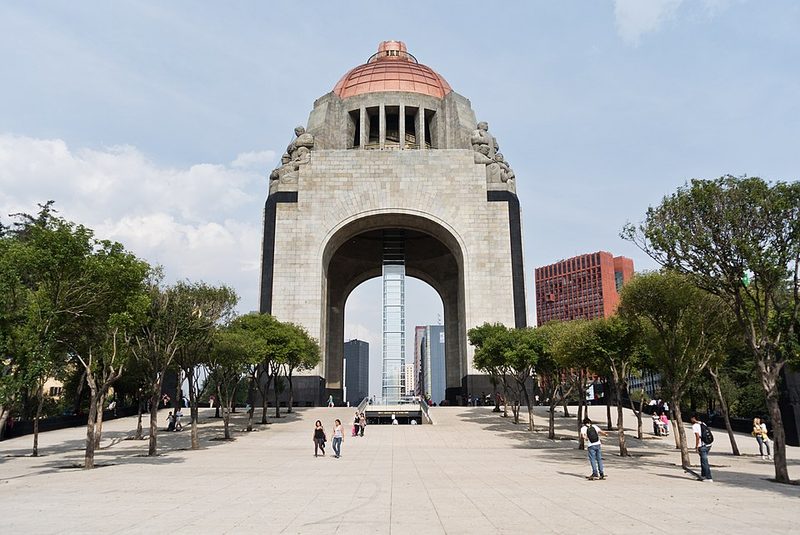
In 1897, Porfirio Diaz commissioned architect Emile Benard to design a Federal Legislative Palace — a grand Beaux-Arts building that would house Congress and serve as a symbol of the Porfiriato’s stability and modernity. Construction began in 1910, the same year Diaz inaugurated the Angel of Independence and the same year the Revolution started. Timing, as they say, was not on his side.
By 1912, with the Revolution in full swing, work stopped. Only the iron and steel framework of the central dome had been completed — a skeleton structure that loomed over the neighborhood with no purpose. The steel had been manufactured by the same firm that built the structure of the Eiffel Tower, which gives you some sense of the ambition involved.
The frame sat abandoned for over twenty years. Various proposals came and went — tear it down, sell the steel for scrap, convert it to something else. In 1933, architect Carlos Obregon Santacilia proposed the solution that stuck: clad the dome in stone, add Art Deco detailing, and convert it into a monument to the Revolution. The poetic justice of repurposing Diaz’s self-aggrandizing legislative palace into a tribute to the uprising that overthrew him was lost on no one.
The monument was completed in 1938 and inaugurated with great ceremony.
The Mausoleum
Like the Angel of Independence, the Revolution Monument doubles as a crypt. Four pillars at the base each hold the remains of a major revolutionary figure:
Francisco I. Madero — The wealthy idealist who triggered the Revolution by challenging Diaz in the 1910 election, forced Diaz into exile, became president, and was murdered in a coup led by Victoriano Huerta in 1913. His assassination is one of the Revolution’s defining tragedies.
Venustiano Carranza — The constitutionalist leader who fought against Huerta and eventually became president, overseeing the writing of Mexico’s 1917 Constitution (still in force). He was assassinated in 1920.
Francisco “Pancho” Villa — The legendary northern guerrilla commander whose Division del Norte was the Revolution’s most feared fighting force. Equal parts folk hero and warlord, Villa was assassinated in 1923. His remains were moved here in 1976, decades after the others — the government remained uneasy about Villa for a long time.
Plutarco Elias Calles — The post-revolutionary president who founded the political party (later renamed the PRI) that would govern Mexico for 71 consecutive years. He was also the man who excluded Iturbide from the Angel of Independence and initiated the Cristero War against the Catholic Church.
A fifth figure, Lazaro Cardenas, was added later — the president who nationalized Mexico’s oil industry in 1938 and carried out the most extensive land reform of the post-revolutionary period. He’s arguably the most beloved of the five.
The collection of figures is revealing. These men fought on different sides of the Revolution, disagreed on almost everything, and in some cases actively tried to kill each other. Burying them together under one dome is either an act of reconciliation or a very dark joke.
What’s Inside and On Top
The Observation Deck
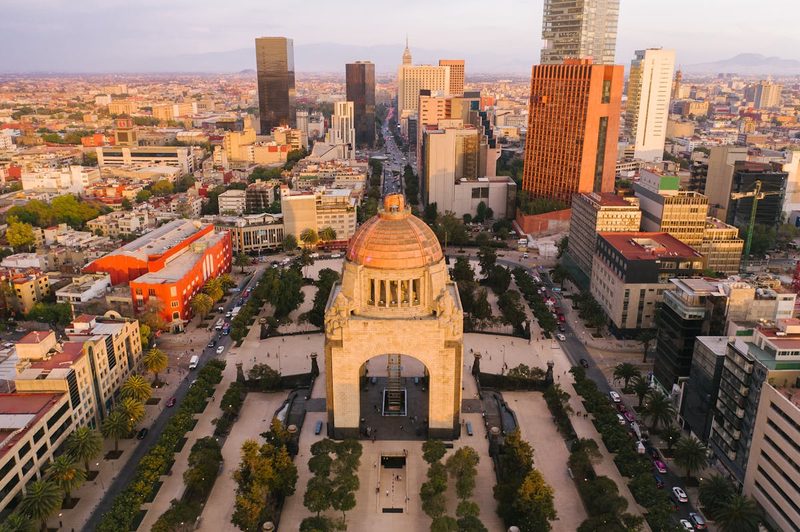
A glass elevator takes you up to an observation deck near the top of the dome — about 65 meters above ground level. The views span the city in every direction: east toward the Historic Center, south toward Condesa and Roma, west toward Chapultepec Castle, north into the sprawl that extends to the horizon.
The elevator ride itself is part of the experience — the glass walls give you an ascending view of the monument’s interior architecture, including the Art Deco stonework and the structural skeleton that was originally meant for a very different building.
Cost is around $100 MXN for adults. The deck is open Tuesday through Sunday, typically 10 AM to 8 PM (check for current hours). Late afternoon is best for warm light; evening gives you the city lights but less architectural detail.
Museo Nacional de la Revolucion
Beneath the plaza, an underground museum covers the Mexican Revolution from the final years of the Porfiriato through the post-revolutionary government formation. The collection includes photographs, weapons, documents, clothing, and personal effects of revolutionary leaders.
It’s not a large museum — you can get through it in an hour — but it provides useful context for everything you’ll see at the monument above. If you’re interested in the Revolution period, pair this with the National History Museum in Chapultepec Castle, which covers the broader sweep of Mexican history.
The Plaza
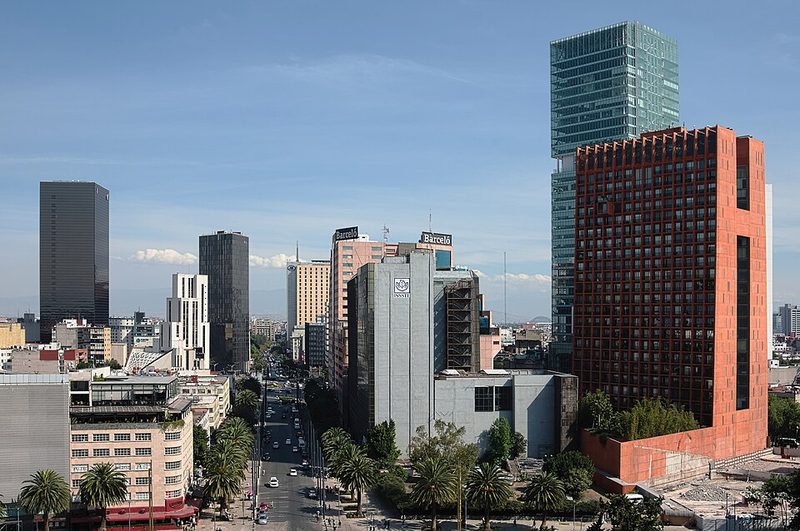
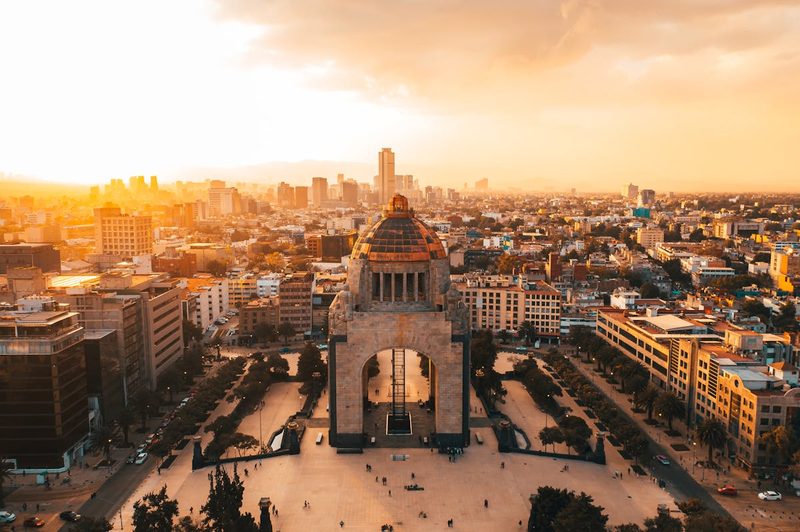
The area around the monument underwent a major renovation in 2010 for the Revolution’s centennial. The result is the Plaza de la Republica — a clean, open public space with fountains that are illuminated at night, seating areas, and a generally welcoming atmosphere that the area lacked for decades.
Before the renovation, the Tabacalera neighborhood around the monument was gritty and largely avoided by tourists. The plaza upgrade has helped, though Tabacalera remains rougher around the edges than Colonia Juarez or Roma. The blocks immediately around the plaza are fine; venture further into the neighborhood with normal big-city awareness.
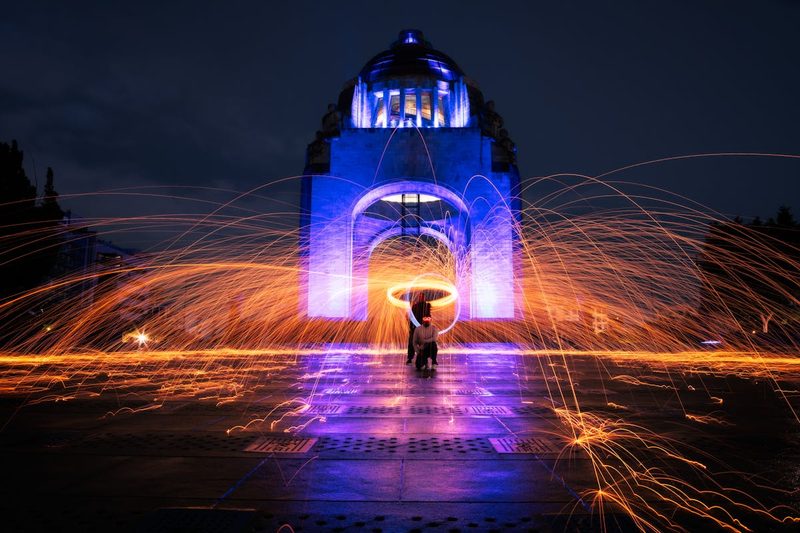
The fountains in the plaza are popular with kids during hot weather. At night, the monument and plaza are illuminated, and the area takes on a different character — calmer, more atmospheric, worth visiting separately from a daytime trip.
How to Get There
Metro: Revolucion station (Line 2) is the closest, about a 5-minute walk south to the monument. Hidalgo station (Lines 2 and 3) is also walkable, about 10 minutes east — this is useful if you’re combining with Alameda Central and the Palace of Fine Arts area.
Metrobus: Line 1 on Insurgentes has a stop at Revolucion, about a 10-minute walk west to the monument.
Walking from Reforma: The monument is about 3 blocks north of Paseo de la Reforma at the intersection with Avenida de los Insurgentes. From the Angel of Independence, it’s roughly a 20-minute walk northwest.
Walking from the Historic Center: About 20 minutes from Alameda Central, heading northwest on Avenida Hidalgo then north on Avenida de la Republica.
Tips
Combine with Alameda Central: The two sites are about 1.5 km apart and make a natural pair — Revolution Monument for 20th-century history, Alameda for colonial-era atmosphere, with the Palace of Fine Arts bridging the gap.
Visit at night: The illuminated monument and fountain show in the plaza are genuinely attractive and less crowded than daytime visits. The observation deck open hours sometimes extend into the evening.
Budget time wisely: The monument itself, mausoleum, and observation deck take about 45 minutes. Add the underground museum for another hour. The plaza is good for a 15-minute sit. Total: 1.5-2 hours if you do everything.
Skip it if: You’re short on time and have to choose between this and the Angel of Independence. The Angel has more immediate visual impact and better backlink — er, better location for connecting to other attractions. The Revolution Monument is worth the trip if you’re interested in the Revolution’s history or want the observation deck views, but it’s not in the “must-see” tier for a first-time visitor with limited days.
The Revolution Monument is one of those places that gets more interesting the more you know about it. A first glance shows a large Art Deco dome in a nice plaza. Knowing that it was meant to be Diaz’s palace, that the steel frame sat abandoned for twenty years, that five men who disagreed about everything lie together beneath it — that turns a pleasant plaza visit into something more layered. Mexico City rewards that kind of knowledge. This monument proves it.