
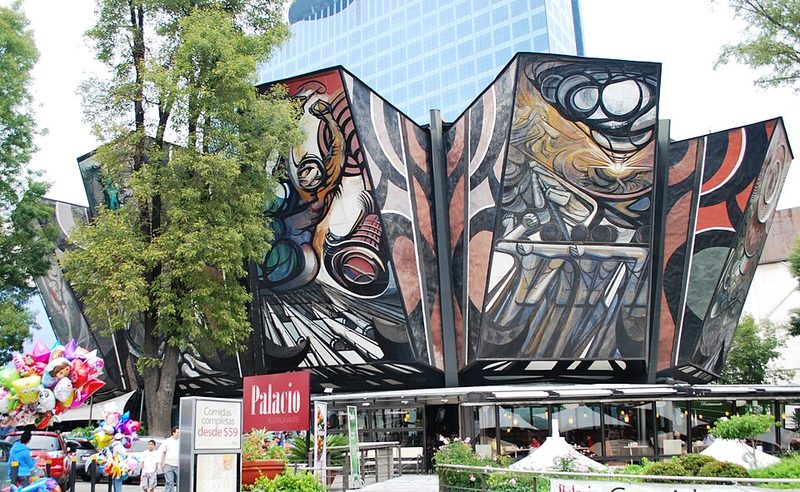
David Alfaro Siqueiros spent the last years of his life working on a single piece of art. It covers approximately 8,700 square meters of interior surface — walls, ceiling, and every angle in between — making it the largest mural in the world. The room it’s painted in is an irregular dodecahedron (twelve-sided polygon) that rotates on its base while light and sound effects play. The whole thing is housed in a building shaped like a flying saucer near the World Trade Center in southern Colonia Napoles.
If that description sounds completely insane, wait until you see it in person.
The Polyforum Cultural Siqueiros is unlike anything else in Mexico City, or anywhere else for that matter. It’s the final statement of one of the 20th century’s most ambitious artists, and regardless of whether you consider it a masterpiece or an act of monumental hubris, it’s an experience you won’t forget.
Siqueiros and the Mexican Muralists

To understand the Polyforum, you need to understand Siqueiros. David Alfaro Siqueiros (1896-1974) was one of the three great Mexican muralists, alongside Diego Rivera and Jose Clemente Orozco. The three shared a commitment to public art as a vehicle for political and social messaging, but their approaches and temperaments were radically different.
Rivera was the most commercially successful, a masterful draftsman who could work in any style. Orozco was the darkest, an expressionist whose murals crackle with anger and despair. Siqueiros was the most radical — politically (he was a committed communist who fought in the Spanish Civil War and was implicated in the first assassination attempt on Leon Trotsky) and artistically (he experimented with industrial materials, new technologies, and spatial compositions that broke every convention of traditional mural painting).
Where Rivera painted flat walls in the tradition of Italian fresco, Siqueiros wanted to explode the frame entirely. He painted on irregular surfaces, used automotive lacquers and synthetic paints, incorporated sculptural elements, and designed murals to be experienced from multiple moving viewpoints. He called his approach “poly-angular” painting and spent decades developing techniques to create murals that surrounded and engulfed the viewer.
The Polyforum was the culmination of everything Siqueiros had worked toward. He started it in 1966 and worked on it until shortly before his death in 1974, though the building opened to the public in 1971.
“La Marcha de la Humanidad” (The March of Humanity)
The mural is titled “La Marcha de la Humanidad en la Tierra y Hacia el Cosmos” — “The March of Humanity on Earth and Toward the Cosmos.” It’s Siqueiros’ vision of human history and destiny, rendered on a scale that defies casual description.
The work covers every interior surface of the upper forum, a twelve-sided room about 20 meters in diameter. The images wrap continuously from wall to ceiling to wall, with no breaks, no frames, and no clear beginning or end. Figures are enormous — some span multiple stories. The color palette is intense: deep reds, blacks, metallic silvers, electric blues. The style is Siqueiros at his most dynamic, with distorted perspectives, foreshortened figures, and a sense of explosive movement.
Thematically, the mural progresses from scenes of human suffering and oppression through revolution and struggle toward a utopian future. It’s explicitly political — Siqueiros was not subtle about his Marxist worldview — but the visual power of the work transcends its ideological content. Even if you find the politics simplistic, the sheer physical impact of standing inside a room covered floor-to-ceiling with thousands of square meters of aggressive, operatic painting is overwhelming.
The Rotating Floor
Here’s where it gets truly unusual. The central viewing area of the upper forum is a rotating platform that turns slowly while spotlights and a recorded narrative guide you through different sections of the mural. As the floor rotates, your perspective on the surrounding images continuously shifts, which is exactly what Siqueiros designed for — his “poly-angular” approach means the composition changes depending on your viewpoint. Figures that appear distorted from one angle snap into correct proportion from another.
The light-and-sound show lasts about 30-45 minutes, depending on the presentation. The narration is typically in Spanish, though English audio guides may be available. The experience is part museum visit, part theatrical performance, and part sensory overload.
The Building
The Polyforum building was designed by architects Guillermo Rossell de la Lama and Ramon Miquelajauregui, in collaboration with Siqueiros, and financed by Manuel Suarez y Suarez, a businessman who also funded the nearby Hotel de Mexico (now the World Trade Center). The exterior is covered with Siqueiros’ work as well — sculptural panels and murals that extend the artistic program to the building’s facade.
The building contains multiple levels:
- Upper Forum: The main event — the rotating room with “La Marcha de la Humanidad.”
- Lower forums: Gallery spaces for temporary exhibitions and cultural events.
- Ground level: A small shop and ticketing area.
- Exterior: The building’s outer walls feature 12 large sculptural-painting panels by Siqueiros, each representing different aspects of humanity’s journey. They’re visible from the street and worth walking around.
The Polyforum has had a complicated recent history. It underwent a major renovation and legal dispute in the late 2010s when the building’s ownership structure changed. As of recent years, the upper forum with the main mural is open for guided visits, though schedules and management have fluctuated. Check current hours before visiting.
Practical Information
Location
The Polyforum is at Insurgentes Sur 701, Colonia Napoles, directly adjacent to the World Trade Center Mexico City. It’s on one of the city’s busiest avenues, and you can’t miss it — the building’s exterior murals announce its presence from blocks away.
Getting There
- Metrobus: Line 1 runs along Insurgentes Sur. The Poliforum stop is right at the door.
- Metro: Etiopia/Plaza de la Transparencia station (Line 3) is about a 10-minute walk.
- From Reforma/Centro: Take the Metrobus south on Insurgentes. It’s about 15-20 minutes from the Historic Center.
Hours and Admission
The Polyforum’s schedule has varied in recent years due to renovations and management changes. The upper forum visits are typically available on specific days with scheduled presentations. Check current hours and availability before going — this isn’t the kind of place where you can just walk in anytime. Admission prices vary but expect around 60-100 MXN.
How Long to Spend
The main experience — the rotating floor presentation of the upper forum mural — takes 30-45 minutes. Add time for the exterior murals and any temporary exhibitions in the lower galleries. Total visit: about 1-1.5 hours.
Context: Siqueiros vs. Rivera
If you’ve already visited Rivera’s murals at the National Palace or the Palace of Fine Arts, the Polyforum provides a fascinating contrast. Rivera was a storyteller — his murals are narrative, readable, and packed with historical detail. Siqueiros was an expressionist — his work is visceral, abstract, and physically overwhelming. Rivera invites you to look. Siqueiros forces you to feel.
Seeing both approaches is essential to understanding the Mexican muralist movement. Rivera gets most of the tourist attention, and deservedly so. But Siqueiros pushed the medium further, experimenting with space, technology, and scale in ways that remain radical today. The Polyforum is his definitive statement, and there’s nothing else like it.
It’s weird, it’s over the top, it’s politically earnest to the point of naivete, and it’s housed in a building that looks like a UFO. We love it.