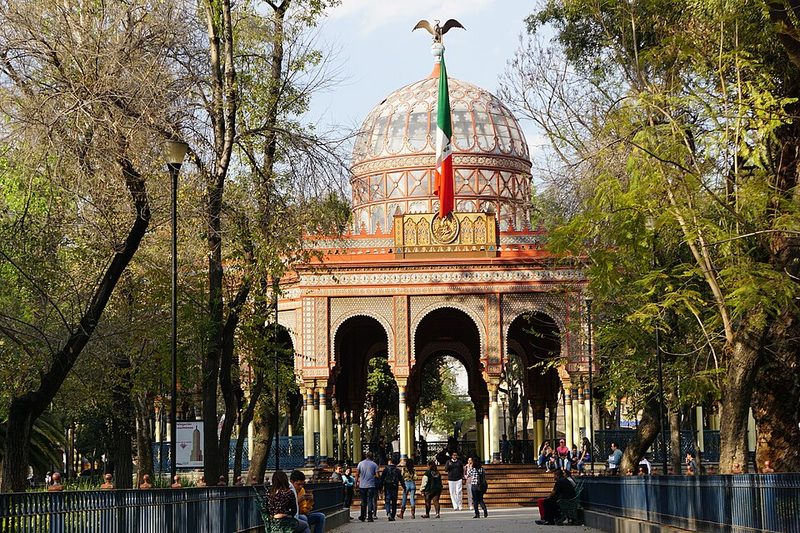
In a quiet residential plaza in the Santa Maria la Ribera neighborhood, surrounded by trees and park benches and the daily routines of a neighborhood that doesn’t see many tourists, there’s an ornate iron pavilion that looks like it was teleported from a different continent. It’s covered in Moorish arches, Islamic geometric patterns, and colored glass, and it sits in the middle of the Alameda de Santa Maria like an elaborate fever dream that someone forgot to take down after a party. This is the Kiosco Morisco — the Moorish Kiosk — and its story is one of the strangest journeys any building in Mexico City has taken.
The kiosk wasn’t built for Mexico City. It wasn’t built for Mexico at all. It was designed for a World’s Fair in New Orleans, manufactured in Pittsburgh, shipped across the Gulf, exhibited in the American South, then dismantled, crated up, and reassembled in Mexico — where it’s been standing, increasingly beloved and slightly improbable, for well over a century.
Built for a World’s Fair
In 1884, New Orleans hosted the World’s Industrial and Cotton Centennial Exposition — one of those grand 19th-century world’s fairs where nations competed to display their industrial prowess, cultural achievements, and general national swagger. Mexico, then under the long dictatorship of Porfirio Diaz, was eager to project an image of modernity and sophistication to the world. The Diaz government invested heavily in its exhibition presence, commissioning elaborate structures to represent the nation abroad.
The Moorish Kiosk was one of these commissions. Engineer Jose Ramon Ibarrola designed it in the neo-Mudejar style — a revival of the Islamic-influenced architecture that had flourished in medieval Spain and, through colonialism, left traces throughout the Spanish-speaking world. The style was fashionable in the late 19th century, part of the broader Orientalism that influenced architecture, art, and design across Europe and the Americas.
Ibarrola’s design is an octagonal pavilion constructed almost entirely of iron, with horseshoe arches on each face, ornamental ironwork throughout, and panels of colored and stained glass. The iron components were manufactured by the foundries of Pittsburgh, Pennsylvania — which in the 1880s was the iron and steel capital of the United States. The kiosk was essentially a Mexican design, executed in American iron, inspired by Spanish-Islamic architecture. It’s a genuinely global object.
The kiosk served as Mexico’s exhibition pavilion at the New Orleans fair, where it housed displays of Mexican products and craftsmanship. By all accounts it was well-received — the combination of exotic design and industrial-quality construction impressed fairgoers. After the exposition ended, the question became: what do you do with a large, ornate iron pavilion that’s now sitting in Louisiana?
The Journey to Mexico City
The Mexican government had the kiosk dismantled, packed into crates, and shipped to Mexico. It was first reassembled on the Alameda Central in downtown Mexico City, the old public park near the Historic Center that had been a gathering place since the colonial period. For a time, it served as a bandstand and social gathering point in one of the city’s most prominent public spaces.
But the kiosk’s time on the Alameda Central didn’t last. In 1910, as part of the centennial celebrations of Mexican independence, the Alameda underwent significant renovations. The Moorish Kiosk was moved to make way for other monuments and improvements. Its new home would be the Alameda de Santa Maria, the central plaza of the Santa Maria la Ribera neighborhood, in the northwestern part of the city.
It’s been there ever since. Over a hundred years in the same spot, which in Mexico City — a place that routinely moves, demolishes, rebuilds, and reconfigures its landmarks — counts as remarkable permanence.
The Design Up Close

If you visit on a quiet weekday, you can take your time walking around and through the kiosk. The details repay attention.
The structure is octagonal, with each face featuring a horseshoe arch — the signature element of Moorish architecture. Above the arches, the ironwork gets increasingly intricate: geometric lattice patterns, floral motifs, and decorative cresting along the roofline. The roof itself is a dome, topped with a finial, and the whole thing is supported by iron columns with stylized capitals.
The colored glass panels, some original and some replaced over the years, filter light into the interior in ways that change throughout the day. In the late afternoon, when the sun is low, the effect is genuinely beautiful — colored light falling across the iron structure, the surrounding trees casting shadows, the whole thing looking like an illustration from a 19th-century travel book.
The ironwork is precise and finely detailed, which makes sense when you remember it was produced by Pittsburgh foundries at the height of American industrial capability. The casting quality is excellent, and even after more than 130 years of exposure to Mexico City’s air, rain, and seismic activity, the structural integrity remains solid. The kiosk has been restored several times — most recently in a significant renovation that cleaned and repainted the iron and replaced damaged glass panels — but the basic structure is the one that was bolted together in the 1880s.
Santa Maria la Ribera

The neighborhood where the kiosk lives is itself worth knowing about. Santa Maria la Ribera is one of Mexico City’s oldest planned colonias, laid out in the 1860s as a residential district for the emerging middle class. It was one of the first neighborhoods built outside the old colonial center, and its grid of streets, central alameda (public garden), and handsome 19th-century houses reflect the optimism and order of the Porfirio Diaz era.
For a long time, Santa Maria la Ribera was overlooked by visitors and even by many capitalinos. It’s not as trendy as Roma Norte, not as polished as Polanco, not as bohemian as Coyoacan. But in recent years it’s been undergoing a slow revival, with new cafes, small galleries, and cultural spaces opening alongside the traditional shops and markets that have been here for decades. The Museo de Geologia (Geology Museum), housed in another ornate Porfiriato-era building, is a few blocks away and is one of the city’s underrated small museums.
The Alameda de Santa Maria itself — the plaza where the kiosk stands — is a classic Mexican neighborhood park. Benches under trees, families on weekend mornings, vendors selling snacks, elderly residents doing their daily walks. It’s the kind of place that gives you a feel for everyday Mexico City life rather than tourist Mexico City, and the kiosk presides over it all like a visiting dignitary who arrived in 1910 and decided to stay.
Visiting the Kiosk
The Moorish Kiosk is in the Alameda de Santa Maria la Ribera, on the block bounded by Salvador Diaz Miron, Doctor Atl, Jaime Torres Bodet, and Sabino streets. The nearest metro station is Buenavista (Line B) or San Cosme (Line 2), both within reasonable walking distance.
There’s no admission charge — the kiosk is an outdoor structure in a public park, so you can visit anytime. That said, the neighborhood is more pleasant during daylight hours, and the colored glass looks best in afternoon light. Plan about 30 minutes for the kiosk itself and the surrounding alameda, more if you want to explore the neighborhood.
The area isn’t packed with other major attractions, but the Geology Museum is worth a stop if you’re already here, and the neighborhood has enough interesting street life, markets, and food options to fill a couple of hours. Several traditional cantinas and fondas (small family restaurants) in the surrounding blocks serve excellent, inexpensive Mexican food.
Combining With Other Visits
From Santa Maria la Ribera, the Revolution Monument is about a 15-minute walk to the south. You could combine the kiosk with the Revolution Monument and its underground museum for a morning that covers two very different pieces of Mexican history. From the Revolution Monument, it’s a straightforward walk east into the Historic Center, where the density of things to see increases dramatically.
The kiosk also works as a deliberate detour for visitors who want to see a side of Mexico City that doesn’t appear in most guides. Santa Maria la Ribera is authentic in the way that word is supposed to mean — a real neighborhood living its real life, with a genuinely extraordinary piece of architectural history sitting in the middle of its park, visited mainly by the people who live there. That’s a rare thing in a city where tourism has transformed many of the most interesting neighborhoods, and it’s one of the reasons the Moorish Kiosk feels so different from better-known landmarks. It hasn’t been polished for visitors. It’s just there, doing what it’s been doing since before the Mexican Revolution, being beautiful and slightly impossible.