
Mexico City has monuments to heroes, monuments to ideas, and monuments to events. The Monumento a Obregon in San Angel is something rarer and stranger: a monument built on the exact spot where a president was shot to death, which for decades displayed one of his preserved body parts. If that sounds like the kind of thing only Mexico could pull off, you’re not wrong. The story behind this monument is one of the wildest in the city.
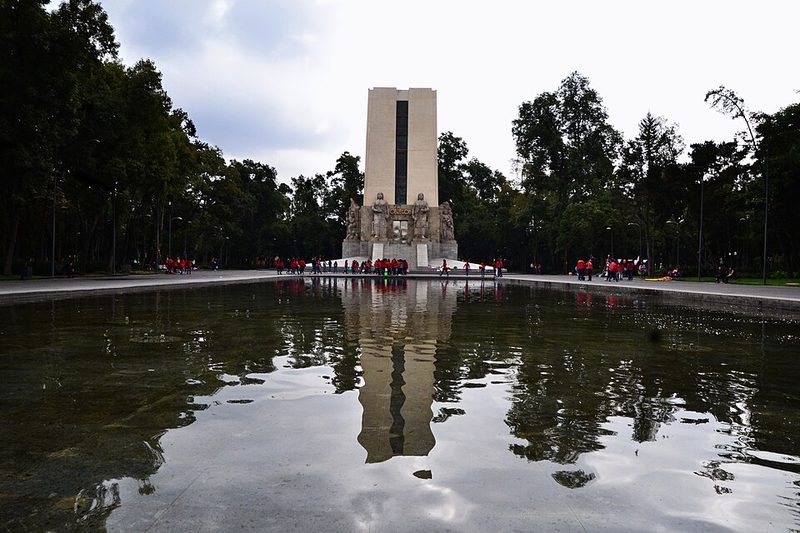
The monument sits in Parque de la Bombilla, a pleasant, tree-filled park in the San Angel neighborhood in southern Mexico City. Most people walking through the park on a sunny afternoon have no idea they’re strolling past the scene of one of the most consequential political assassinations of the 20th century. The monument itself is a handsome Art Deco structure that tells you something serious happened here, but it takes a bit of backstory to understand just how serious — and how weird — that something was.
The Assassination of Alvaro Obregon
Alvaro Obregon was one of the key military leaders of the Mexican Revolution and served as president from 1920 to 1924. He was a complex figure — a brilliant military tactician who lost his right arm in the Battle of Celaya in 1915 (a grenade), a political pragmatist who helped stabilize post-revolutionary Mexico, and also an ambitious man who, after his first term, worked to amend the constitution so he could run for president again. He won the 1928 election, which was itself controversial, since the original revolutionary constitution had been explicitly designed to prevent exactly this kind of re-election.
On July 17, 1928, before he could take office for his second term, Obregon attended a banquet at a restaurant called La Bombilla in San Angel. A young artist named Jose de Leon Toral approached the president-elect’s table, ostensibly to show him caricature drawings he’d sketched of the guests. When Toral got close enough, he pulled out a pistol and shot Obregon multiple times. Obregon died at the scene.
Toral was a Catholic militant who opposed the anti-clerical policies of the ruling revolutionary government. The Cristero War — a violent conflict between the Mexican government and Catholic rebels — was raging at the time, and Toral saw the assassination as a religious act. He was arrested immediately, tried, and executed by firing squad in February 1929. A nun named Madre Conchita (Concepcion Acevedo de la Llata) was convicted as the intellectual author of the plot and imprisoned for decades.
The assassination threw Mexican politics into crisis. Without Obregon, the incoming government had to reorganize quickly, and the political maneuvering that followed eventually led to the creation of the political party that would rule Mexico for the next 71 years — the PNR, later renamed the PRI. In a sense, the bullet that killed Obregon at La Bombilla restaurant shaped the entire trajectory of modern Mexican politics.
The Monument
The restaurant was demolished, and in its place the government built a monument to the fallen president-elect. Designed by architect Enrique Aragon Echegaray in the Art Deco style that was fashionable in the late 1920s and 1930s, the Monumento a Obregon is a cylindrical stone structure with clean geometric lines, flanked by pillared walkways. It’s not massive — it doesn’t try to compete with the Angel of Independence or the Revolution Monument — but it has a dignified solidity that suits its purpose.
The Art Deco details are worth noting. The exterior features carved stone panels with geometric and revolutionary motifs, and the proportions have that characteristic Deco combination of weight and elegance. Inside, the monument was designed as a memorial chamber, with a statue of Obregon and inscriptions commemorating his military and political career.
The monument was inaugurated in 1935, seven years after the assassination. President Lazaro Cardenas, who had risen to power through the political system that Obregon’s death inadvertently created, presided over the ceremony.
The Arm
Now we get to the part that makes this monument unlike any other in Mexico City, or possibly anywhere.
Remember that Obregon lost his right arm at the Battle of Celaya in 1915. The arm was recovered from the battlefield, and rather than being buried or discarded, it was preserved in formaldehyde. After the monument was built, the preserved arm was placed inside in a glass jar filled with preservative fluid, displayed as a relic of the revolutionary hero.
For over fifty years, visitors to the monument could see Obregon’s actual arm floating in a jar. It became one of Mexico City’s most macabre tourist attractions — the kind of thing locals would bring visiting relatives to see, half as a history lesson and half for the shock value. Guidebooks mentioned it. Schoolchildren were brought on field trips. An actual human arm in a jar, inside a government monument, in the middle of a public park. Mexico has always had a different relationship with death than most countries, but even by local standards, this was something.
In 1989, President Carlos Salinas de Gortari ordered the arm removed and cremated, apparently at the request of the Obregon family. The ashes were reportedly interred with the rest of Obregon’s remains. The jar and its contents are gone, and the monument’s interior was remodeled. Today, the memorial chamber contains a statue of Obregon but no preserved body parts, which is probably for the best from a museum conservation standpoint if nothing else.
Parque de la Bombilla
The monument sits at the center of Parque de la Bombilla, which takes its name from the restaurant where the assassination took place. The park is a pleasant, mid-sized green space with mature trees, walking paths, and benches. It’s popular with joggers, dog walkers, and families, especially on weekends.
The park’s atmosphere is at odds with its history. On a sunny Saturday afternoon, with kids running around and couples sitting under trees, it’s hard to reconcile the scene with the violent political drama that took place on this same ground. But that contrast is part of what makes Mexico City’s relationship with its own history so interesting — the city doesn’t cordon off its dark chapters. It builds parks on top of them and lets people play frisbee.
Parque de la Bombilla also hosts cultural events periodically, including outdoor performances, art installations, and neighborhood festivals. The park connects easily to the broader San Angel area and serves as a useful landmark when navigating the neighborhood.
Visiting
The monument is in Parque de la Bombilla on Avenida de la Paz in San Angel. It’s free to visit and accessible during park hours (roughly 6 AM to 8 PM daily). The interior of the monument is sometimes open to visitors, though hours can be inconsistent — if you find it locked, the exterior and the park itself are still worth the stop.
The best way to visit is as part of a San Angel day. The neighborhood is one of Mexico City’s most charming, with cobblestone streets, colonial-era churches, and a village atmosphere that feels distinct from the rest of the city. On Saturdays, the Bazar Sabado brings an art and craft market that draws crowds from across the city. The Diego Rivera and Frida Kahlo Studio Museum is nearby — the famous paired houses designed by Juan O’Gorman, where the two artists lived and worked.
From Parque de la Bombilla, you can walk south deeper into San Angel’s historic streets, where you’ll find the Plaza San Jacinto, the Ex-Convento del Carmen (with its own collection of mummies, because San Angel apparently has a thing about displaying the dead), and numerous restaurants and cafes that make the area a full afternoon destination.
Why It’s Worth a Visit
The Monumento a Obregon isn’t a must-see in the way that Chapultepec Castle or the Anthropology Museum are must-sees. You won’t find it on most top-ten lists. But it’s one of the most historically loaded spots in the city — a place where a single bullet reshaped an entire country’s political future — and the story of the arm gives it a character that no other monument in Mexico City can match. Combined with the park and the San Angel neighborhood around it, it makes for a genuinely interesting stop that most visitors completely miss.