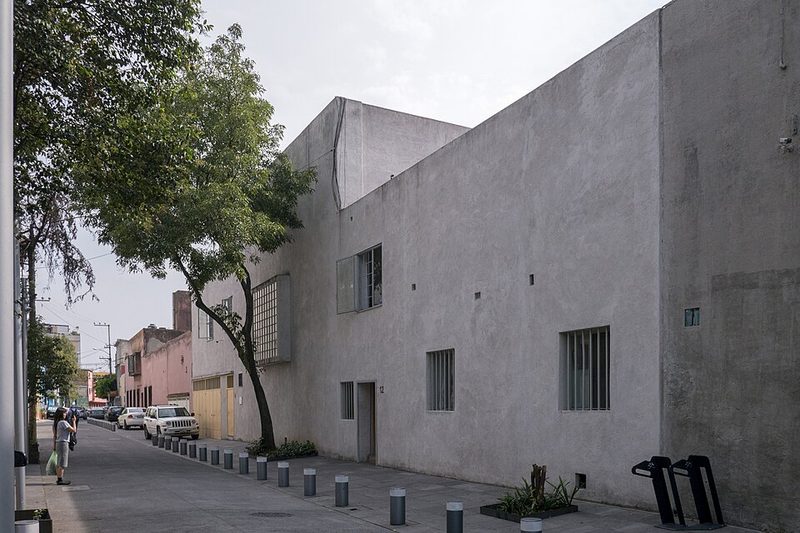
There are exactly two single-family houses in the world with UNESCO World Heritage status. One is the Rietveld Schroder House in Utrecht, Netherlands. The other is in Tacubaya, Mexico City, on a quiet residential street that gives absolutely no indication of what’s behind its plain concrete facade.
The Luis Barragan House and Studio is the former home of Mexico’s most celebrated architect, the man who won the Pritzker Prize in 1980 and whose influence on modern architecture extends far beyond Mexico. He designed it in 1948, lived and worked here until his death in 1988, and left behind a building that’s considered one of the most important works of 20th century residential architecture anywhere.
We think it’s one of the most powerful architectural experiences available in Mexico City — but you need to plan ahead, because you can’t just show up.
Who Was Luis Barragan?

Luis Ramirez Barragan Morfin was born in Guadalajara in 1902 and trained as a civil engineer (architecture wasn’t yet a separate degree at the University of Guadalajara). After graduating in 1923, he traveled extensively in Europe, where he encountered the gardens of southern Spain and North Africa, the writings of Ferdinand Bac, and the work of Le Corbusier. Those influences would simmer for decades before emerging in his mature style.
Barragan’s early work in Guadalajara drew on Mediterranean and Art Deco traditions. When he moved to Mexico City in 1936, he initially pursued a functionalist International Style, designing apartment buildings and commercial projects. But by the mid-1940s, he’d grown dissatisfied with pure functionalism and began developing something entirely his own — an architecture of thick walls, bold colors, dramatic light, water features, and emotional intensity that drew equally from Mexican vernacular building traditions and European modernism.
His house in Tacubaya was the manifesto of this new direction. Everything he believed about architecture — that buildings should provoke serenity, mystery, and wonder; that color and light are structural elements as important as concrete and steel; that privacy is a fundamental human need — is expressed here with absolute conviction.
The House: What You’ll See
From the street, the house is aggressively modest. A plain gray concrete wall with a single wooden door. No signage beyond a small UNESCO plaque. You’d walk right past it without noticing, which is exactly what Barragan intended. The architecture begins the moment the door opens.
The Vestibule and Hall
You enter through a narrow vestibule with volcanic stone floors and pink walls that immediately sets the tone: this is going to be about color, light, and spatial surprise. The hallway leads to a small courtyard with a water feature and lush vegetation pressing against the glass. Light filters through yellow glass panes, casting a warm glow that changes character throughout the day.
The Living Room
The main living area is large but feels intimate, divided into zones by furniture groupings and changes in floor level. The ceiling is high. One wall is entirely glass, opening to the garden. The opposite wall is dominated by a massive fireplace with a concrete mantel. The room’s famous feature is the enormous window that frames the garden like a painting — a technique Barragan used repeatedly, blurring the boundary between interior and exterior space.
The colors in this room shift depending on the time of day and weather. Sunlight bouncing off colored walls in the garden sends reflected hues into the interior. It’s architecture designed to change with the hours, never looking exactly the same twice.
The Library
Barragan’s library occupies a two-story space with floor-to-ceiling bookshelves accessed by a wooden ladder. The books are still there — art, architecture, philosophy, landscape design. A simple wooden desk sits near the window. The room feels lived-in, as if its owner just stepped out for coffee. It’s the most emotionally resonant space in the house for many visitors.
The Studio
Connected to the house but with its own entrance from the street, the studio is where Barragan worked. It’s a more austere space — white walls, a large drafting table, north-facing light. The contrast with the residential spaces is deliberate: the studio is about clarity and focus, the house about warmth and contemplation.
The Garden
Barragan considered the garden as important as the house itself. It’s not large, but it’s layered with volcanic rock walls, mature trees, and ground cover that creates a sense of enclosure and privacy remarkable for a property in the middle of a city. A pink wall at the far end catches afternoon light and sends it radiating back toward the house. The interplay between the garden’s vegetation and the colored walls of the house is what makes photographs of the interior so striking — it’s the garden providing half the atmosphere.
The Rooftop Terrace
The roof terrace is a minimalist composition of white walls against the sky. The walls frame specific views while blocking others, controlling what you see and how you experience the space above the house. It’s pure Barragan — architecture as the curation of light and perception.
The UNESCO Designation
The house received UNESCO World Heritage status in 2004, cited as “an outstanding example of the creative work of Luis Barragan in the post-World War II period” and recognized for integrating “traditional and vernacular currents and elements into a new synthesis.” The listing specifically notes the house’s influence on contemporary architecture worldwide.
The designation has been both a blessing and a complication. It guarantees the house’s preservation and has brought international attention, but it also imposes restrictions on modifications and has made managing visitor access more complex. The house is now owned and operated by the Fundacion de Arquitectura Tapatia Luis Barragan and the Gobierno del Estado de Jalisco.
Visiting: What You Need to Know
Reservations Are Required
You cannot visit without a reservation. There are no walk-ins, no exceptions, no “we’ll see if there’s room.” The house is a small residential building, not a museum, and they limit visits to preserve the structure and maintain the experience. Tours accommodate a maximum of six people at a time.
Book through the official website (casaluisbarragan.org) as far in advance as possible. Weekend slots sell out weeks ahead, especially during high season (November through March). Weekday morning visits are easier to get. The tour lasts approximately one hour.
Tour Format
Tours are guided and conducted in Spanish and English. The guide takes you through every major space in the house and studio, explaining Barragan’s design philosophy, the specific materials and techniques used, and the history of the building. Photography policies change periodically — as of our last visit, interior photography was not permitted during the standard tour but was available on special photography tours at a higher price.
Cost
Standard tours run approximately 400 MXN for foreign visitors and less for Mexican nationals. Photography tours cost more. Check the website for current prices, as they adjust periodically.
Getting There
The house is at General Francisco Ramirez 12-14, Colonia Daniel Garza, Tacubaya. The nearest Metro stations are Constituyentes (Line 7) and Tacubaya (Lines 1, 7, and 9), both about a 10-15 minute walk. An Uber from central Chapultepec takes about 10 minutes.
The surrounding neighborhood of Tacubaya is a working-class area without much tourist infrastructure. There aren’t many restaurants or cafes near the house, so plan your meals before or after the visit. San Angel is a short taxi ride south and has excellent dining options.
What to Pair It With
If you’re on an architecture-focused day in Mexico City, combine the Barragan House with:
- Museo Experimental El Eco — Mathias Goeritz’s experimental gallery in Colonia San Rafael, another landmark of Mexican mid-century modernism.
- San Angel — The San Angel neighborhood has colonial architecture, the Diego Rivera and Frida Kahlo studio-houses, and excellent Saturday market.
- UNAM Campus — Juan O’Gorman’s mosaic-covered central library and Felix Candela’s cosmic ray pavilion continue the modernist theme.
Why It Matters
Barragan’s house matters because it proposed an alternative to the glass-and-steel orthodoxy that dominated postwar architecture. While Mies van der Rohe was eliminating walls and Le Corbusier was lifting buildings on pilotis, Barragan was building thick walls, painting them pink and magenta, filling courtyards with water, and insisting that architecture’s highest purpose was to create spaces for contemplation and emotional experience.
He was right. The house feels as radical today as it did in 1948. Every Instagram-famous architect experimenting with colored concrete and indoor-outdoor flow is working in Barragan’s shadow, whether they know it or not. Standing in his living room, watching afternoon light filter through the garden and paint the walls gold, you understand that architecture at its best isn’t about innovation for its own sake. It’s about making people feel something.
That’s worth the advance planning.