A Rockefeller destroyed Diego Rivera’s mural. Rivera painted it again, bigger, in the most beautiful building in Mexico. That’s the kind of story the Palace of Fine Arts tells — one where art wins, money loses, and the building itself is the punchline to a joke that took thirty years to finish.
The Palacio de Bellas Artes sits on the western edge of the Historic Center, right next to Alameda Central park. It’s impossible to miss. The white marble exterior catches the light from blocks away, and the orange-tiled dome rises above the surrounding rooftops like something that wandered in from a different century. Which, in a way, it did — two different centuries, actually, since the building was started in 1904 and not finished until 1934.
We think it’s the single most impressive building in Mexico City, and we don’t say that lightly in a city where the competition includes the Metropolitan Cathedral, the Postal Palace, and Chapultepec Castle. What makes Bellas Artes special isn’t just how it looks from the outside (though that’s remarkable). It’s the murals inside, the story behind them, the one-of-a-kind Tiffany glass curtain, and the fact that this building has been sinking into the earth since before it was even finished.
Two Architects, Two Styles, Thirty Years Apart
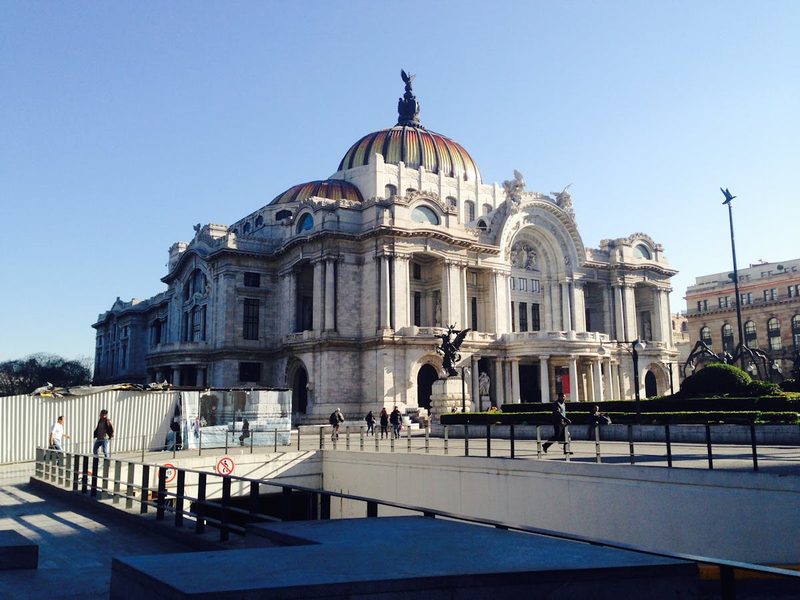
The Palace of Fine Arts was never supposed to take thirty years to build. The original plan was to have it done by 1910 for the centennial celebrations of Mexican Independence. President Porfirio Diaz wanted something grand — a national theater that would prove Mexico City could stand alongside Paris, Vienna, and Rome as a capital of culture. He hired Italian architect Adamo Boari to design it.
Boari was already working in Mexico City. He’d designed the Postal Palace across the street, and Diaz liked what he saw. For the new theater, Boari went big. He envisioned a building in the Art Nouveau and Neoclassical styles that were fashionable in early 1900s Europe — sweeping curves, ornamental ironwork, classical sculpture, and enough marble to bankrupt a quarry.
The first stone was laid on October 1, 1904. Boari promised a grand metallic structure unlike anything that existed outside the United States, and certainly nothing at this scale. He sourced beige marble from Yautepec in Morelos for the lower structure, white marble from Buenavista de Cuellar in Guerrero, and — because why not — more white marble from Carrara, Italy. The same Carrara marble Michelangelo used.
Then Everything Went Wrong
By 1913, with the 1910 deadline long past, the building was barely a shell. Two problems had collided. First, the project was far more complicated than anyone anticipated. Mexico City sits on the bed of a former lake, and the subsoil is soft, spongy, and deeply unhappy about having an enormous marble building placed on top of it. The structure started sinking almost immediately.
Second, Mexico was falling apart politically. The instability that would become the Mexican Revolution was making it impossible to maintain funding, supply chains, or any kind of construction schedule. By 1913, full hostilities had broken out. Boari packed up and returned to Italy. The half-built theater sat empty.
For twenty years.
Picture that for a moment. A partially completed marble palace, sitting in the middle of one of the largest cities in the Americas, slowly sinking into the mud, while revolution, counter-revolution, and political upheaval swirled around it. For two entire decades, nobody could agree on what to do with the thing.
Federico Mariscal Finishes the Job
In 1932, construction finally resumed under Mexican architect Federico Mariscal. The world had changed completely since 1904. Art Nouveau was out. Art Deco was in. Mariscal didn’t try to replicate Boari’s original interior plans — he updated them to the new style. This is why the Palace of Fine Arts looks the way it does: the exterior is Art Nouveau and Neoclassical (Boari’s work from the 1900s), and the interior is Art Deco (Mariscal’s work from the 1930s).
The result shouldn’t work. Mixing two distinct architectural movements from different eras in the same building sounds like a recipe for aesthetic whiplash. Instead, it’s one of the most compelling architectural experiences in the city. You walk in through Boari’s ornate, curving, European-influenced exterior, and suddenly you’re standing in Mariscal’s geometric, angular, distinctly Mexican Art Deco interior. Pre-Hispanic motifs done in Art Deco style — serpent heads on window arches, Maya Chaac masks on the light panels — give the inside a character completely different from the European-flavored outside.
The building was inaugurated on November 29, 1934. The first performance was “La Verdad Sospechosa” by Juan Ruiz de Alarcon. Thirty years, two architects, a revolution, and constant sinking, and they finally had their national theater.
The Building: What You’re Looking At
The main facade faces Avenida Juarez, and it’s worth spending some time outside before you go in. The sculptures across the exterior are by Italian artist Leonardo Bistolfi — a central figure called “Harmony” surrounded by allegorical figures representing Pain, Rage, Happiness, Peace, and Love. Additional sculptures feature cherubs and figures representing music and inspiration. It’s the kind of decoration that would look excessive on most buildings but feels exactly right on this one.
On the plaza in front of the building, you’ll find four Pegasus sculptures by Spanish artist Agusti Querol Subirats. These were originally placed at the Zocalo before being moved here. They’re popular photo spots, and for good reason — bronze winged horses against white marble, with Torre Latinoamericana rising directly across the street. It’s one of the best compositions in the city.
The Dome
The glass and iron roof covering the center of the building was designed by Hungarian artist Geza Maroti. It depicts the muses with Apollo, and from inside the main hall, you can look up through all three floors to see it. On a clear day, colored light pours down through the glass and fills the interior with something that photographs simply can’t capture. You have to stand there and look up.
The Interior Layout
Inside, the Palace is divided into three main sections: the central hall with adjoining exhibition spaces, the theater, and the offices of the Instituto Nacional de Bellas Artes (INBA). The main hall is the first thing you see when you enter — a soaring space covered by Maroti’s glass and iron roof, with balconies on all three upper floors visible from below.
The first floor holds crystal lamps created by the French metalworker Edgar Brandt, along with murals by Rufino Tamayo. The Adamo Boari and Manuel M. Ponce halls host music and literature events. The second floor has smaller exhibition spaces plus the majority of the building’s famous murals — works by Jose Clemente Orozco, David Alfaro Siqueiros, Diego Rivera, Jorge Gonzalez Camarena, Roberto Montenegro, and Manuel Rodriguez Lozano. The third floor houses the Museum of Architecture.
At the entrance to the theater, bronze mascarons depict Tlaloc and Chaac — the Aztec and Maya water deities — designed by Gianette Fiorenzo. Above the stage, representations of mythological figures including the Muses with Apollo were constructed in Hungary in Maroti’s workshops. The ironwork throughout was designed in Italy by Alessandro Mazzucotelli and in Mexico by Luis Romero Soto.
The Tiffany Glass Curtain
This is the thing everyone talks about, and it deserves every word.
The stage curtain at the Palace of Fine Arts isn’t fabric. It’s a stained glass panel made from nearly one million pieces of iridescent colored glass, manufactured by Tiffany Studios in New York. It weighs 24 tons. It’s the only curtain of its type in any opera house in the world.
Let that sink in. Twenty-four tons of Tiffany glass, folding and unfolding before performances, in an opera house that’s been sinking into a former lakebed for over a century. The engineering required to make this work — to move something that heavy smoothly and reliably, performance after performance, decade after decade — is almost as impressive as the curtain itself.
The design depicts the Valley of Mexico as seen from the theater, with the volcanoes Popocatepetl and Iztaccihuatl in the center. Around them is a Mexican landscape surrounded by images of sculptures from Yautepec and Oaxaca. The design was inspired by the work of Gerardo Murillo, better known as Dr. Atl, the painter who was famously obsessed with Mexico’s volcanoes.
You can see the curtain displayed during certain performances and at scheduled showings. If you’re visiting specifically for the curtain (and plenty of people do), check the schedule at the box office. The Ballet Folklorico de Mexico performances are a reliable opportunity to see it, since the curtain is raised before those shows. Watching a million pieces of colored glass catch the light as they rise above the stage is one of those moments that makes you understand why people built this place.
The Murals: Mexico’s Greatest Hits on Plaster
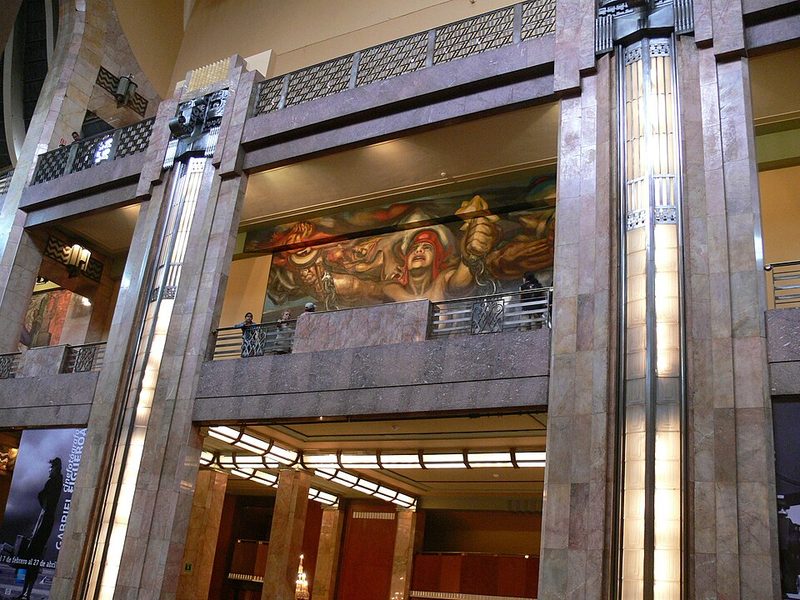
The Palace of Fine Arts contains some of the most important murals in Mexico, which is saying something in a country where muralism was essentially a national art movement. The big names are all here: Rivera, Siqueiros, Orozco, Tamayo, and Gonzalez Camarena. You could spend an entire afternoon just on the murals and still miss details.
Diego Rivera: Man, Controller of the Universe
This is the mural with the story. It occupies the west end of the third floor, and it’s the reason many visitors come to Bellas Artes in the first place.
In 1933, Rivera was commissioned to paint a mural in the lobby of the RCA Building at Rockefeller Center in New York. The Rockefeller family knew Rivera was a communist. They hired him anyway, partly because Abby Aldrich Rockefeller was a patron of his work, and partly because Rivera was one of the most famous artists in the world. The agreed-upon theme was “Man at the Crossroads Looking with Hope and High Vision to the Choosing of a New and Better Future.” Heavy title. Rivera took it literally.
The original composition depicted a worker controlling machinery at the center, flanked by contrasting visions of capitalism and socialism. On one side, wealthy women played cards and smoked while soldiers and war machinery loomed above. On the other side, Vladimir Lenin held hands with a multi-racial group of workers beneath a Soviet May Day rally with red flags.
Here’s where the story gets good. Rivera had shown the Rockefellers a sketch before starting. Nelson Rockefeller looked at it and concluded there was nothing controversial. But as work progressed, Rivera added Lenin’s portrait — a detail that hadn’t been in the approved sketch. When the New York World-Telegram published a story calling the mural “anti-capitalist propaganda,” Nelson Rockefeller asked Rivera to remove Lenin. Rivera refused.
In May 1933, Rockefeller ordered the mural plastered over. Rivera was paid his full $21,000 fee but was barred from finishing the work. The incomplete mural was peeled off the wall in 1934 and destroyed. Only black-and-white photographs survive of the original, taken by Rivera’s assistants when they suspected it might be demolished.
Rivera’s response was perfect. He took those photographs and recreated the entire composition — bigger, with more detail, and with even more Lenin — right here in the Palace of Fine Arts. He titled the new version “Man, Controller of the Universe” (a subtle upgrade from the original title) and painted it in 1934, the same year the original was destroyed. The mural measures 4.85 by 11.45 meters.
Standing in front of it, you’re looking at an act of artistic defiance preserved in plaster. A billionaire destroyed it; an artist rebuilt it. The billionaire’s version is gone. The artist’s version is still here, in a building that’s been called the “Cathedral of Art in Mexico.” We’d call that a win.
David Alfaro Siqueiros: New Democracy
On the north side of the third floor, Siqueiros’ three-part “La Nueva Democracia” (New Democracy) from 1945 is impossible to miss. Siqueiros was the most politically radical of the three great muralists (Rivera, Orozco, and Siqueiros), and his style matches — dynamic, aggressive, with figures that seem to burst out of the wall toward the viewer. The central figure of Democracy breaking free from chains is one of the most recognizable images in Mexican art.
Siqueiros had actually participated in the Mexican Revolution as a soldier and later fought in the Spanish Civil War. He also once participated in an assassination attempt on Leon Trotsky (who was living in exile in Mexico at the time). The man lived his politics. His murals have an urgency that reflects that.
Jose Clemente Orozco: Catharsis
At the east end of the third floor, Orozco’s “La Katharsis” (Catharsis) depicts the conflict between humanity’s social and natural aspects. It’s darker and more pessimistic than Rivera’s work — Orozco didn’t share Rivera’s faith in political solutions. Where Rivera saw a future controlled by enlightened workers, Orozco saw chaos, corruption, and violence as permanent features of human existence. His palette is darker, his figures more tormented, and the overall effect is closer to Goya than to Soviet social realism.
Orozco was the first of the great muralists to be honored with a memorial service at Bellas Artes, in 1949. Rivera followed in 1957, and Siqueiros in 1974. All three painted on these walls. All three were mourned within them.
Rufino Tamayo: Birth of Nationality and Mexico Today
On the second floor, two murals by Rufino Tamayo from the early 1950s offer a different perspective. “Nacimiento de la Nacionalidad” (Birth of Nationality) is a symbolic depiction of the creation of the mestizo identity — the blending of indigenous and Spanish heritage that defines modern Mexico. “Mexico de Hoy” (Mexico Today) is its companion piece.
Tamayo’s style is notably different from the other three. Less overtly political, more focused on color, form, and symbolic imagery. His murals at Bellas Artes are a good introduction to his work — you can see how he took the muralist tradition and pushed it toward something more abstract and personal. If Rivera’s work here makes you want to see more, his home studio in San Angel (now the Diego Rivera Studio Museum) is worth the trip south.
Jorge Gonzalez Camarena and Others
The walls also hold Rivera’s four-part “Carnaval de la Vida Mexicana” (Carnival of Mexican Life) on the north side of the third floor, along with works by Jorge Gonzalez Camarena, Roberto Montenegro, and Manuel Rodriguez Lozano. Gonzalez Camarena’s “Liberacion” (Liberation, or “Humanity is Released from Misery”), painted in 1963, is one of the later additions and holds its own against the more famous works nearby.
The Theater and Performances
The theater has a seating capacity of 1,590, and it hosts some of the most important performing arts events in Mexico. The acoustics are solid (they underwent modernization starting in 2009), and the sight lines are good from most seats. But honestly, even a mediocre performance would feel elevated by the setting. Between the Tiffany curtain, the Art Deco detailing, the bronze mascarons at the entrance, and the general sense that you’re sitting inside a national treasure, the experience goes beyond whatever’s on stage.
Two groups perform here regularly. The Ballet Folklorico de Mexico puts on shows twice a week — a spectacle of pre-Hispanic and regional dance from across Mexico. A typical program includes Aztec ritual dances, agricultural dances from Jalisco, a fiesta set in Veracruz, and wedding celebrations, all accompanied by mariachis, marimba players, and singers. It’s tourist-friendly but genuinely well done, and it’s one of the best ways to see the Tiffany curtain in action.
The Compania Nacional de Opera de Bellas Artes and the National Symphonic Orchestra also perform regularly. Maria Callas made her debut here in 1950, singing Norma. Luciano Pavarotti performed here multiple times. If you’re in town and any performance at Bellas Artes fits your schedule, go. The building alone is worth the ticket price.
The Sinking Problem
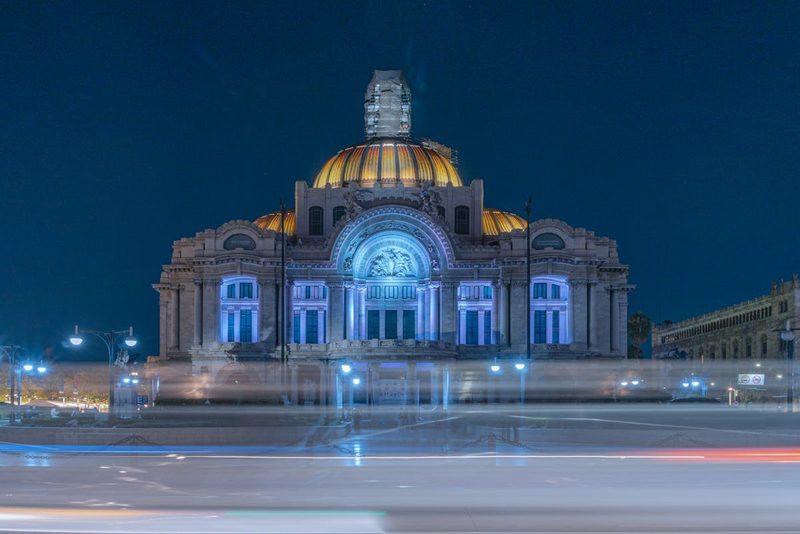
Since construction began in 1904, the Palace of Fine Arts has sunk approximately four meters into Mexico City’s soft subsoil. Four meters. That’s roughly thirteen feet. The building is measurably lower than it was when Boari laid the first stone.
This isn’t unique to Bellas Artes — the Metropolitan Cathedral at the Zocalo has the same problem, as do many buildings in the Historic Center. Mexico City was built on the bed of Lake Texcoco, and the clay subsoil compresses under heavy loads. A building made of marble from three different countries, with a 24-ton glass curtain inside, qualifies as a heavy load.
You can see evidence of the sinking when you approach the building. The entrance level is noticeably lower than the surrounding street grade. Steps that were once at ground level now require you to walk down to reach them. It’s the kind of thing you might not notice unless someone points it out, but once you see it, you can’t unsee it.
Engineers have been managing the sinking for decades, and the building remains structurally sound. But it’s a reminder that everything in this part of Mexico City is, on a geological timescale, slowly returning to the lake.
The Museums Inside
Museo del Palacio de Bellas Artes
The Museum of the Palace of Fine Arts manages the permanent murals and arranges temporary exhibitions covering painting, sculpture, photography, and other media. The temporary shows are often excellent — they’ve hosted multiple exhibitions of Frida Kahlo’s work over the years, along with shows featuring international artists. The exhibitions rotate regularly, so it’s worth checking what’s on before your visit.
Museo Nacional de Arquitectura
The National Museum of Architecture occupies the top floor, directly beneath Maroti’s glass and iron roof. It features exhibitions from major Mexican architects including models, designs, and photographs. If you’ve been walking through the Historic Center admiring the buildings, this museum gives you context for what you’ve been seeing. Look for the work of Luis Barragan, Adamo Boari, and others. The museum is divided into four sections and also hosts temporary exhibitions on contemporary architecture.
Memorial Services: Where Mexico Mourns Its Artists
The Palace of Fine Arts has a function that no other building in Mexico serves: it’s where the nation says goodbye to its most important cultural figures. Since Jose Clemente Orozco’s memorial in 1949, sixty-five people have been honored with funeral tributes at Bellas Artes.
The list reads like a who’s who of Mexican culture. Frida Kahlo in 1954. Diego Rivera in 1957. Agustin Lara in 1970. David Alfaro Siqueiros in 1974. Juan Rulfo in 1986. Rufino Tamayo in 1991. Cantinflas in 1993. Octavio Paz in 1998. Maria Felix in 2002. Carlos Fuentes in 2012. Gabriel Garcia Marquez in 2014. Juan Gabriel in 2016.
There’s something moving about the fact that artists are mourned in the same building where their work lives. Rivera’s memorial service was held in the same room as his mural. The man who painted “Man, Controller of the Universe” as an act of defiance against a Rockefeller was eulogized beneath it.
Practical Visiting Information
Location and Getting There
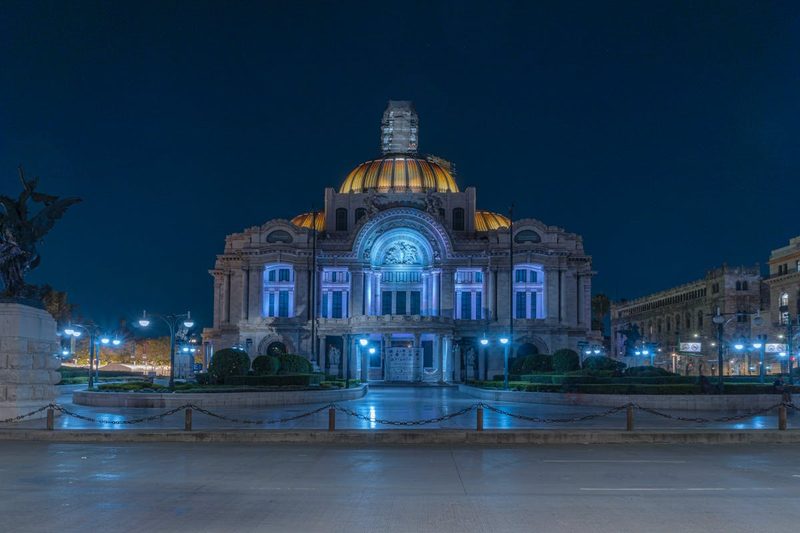
The Palace of Fine Arts is at the corner of Avenida Juarez and the Eje Central, on the western edge of the Historic Center. Alameda Central park is directly next door to the south. The Postal Palace — designed by the same architect, Adamo Boari — is across the street to the northeast. Torre Latinoamericana stands directly across the Eje Central.
The nearest Metro station is Bellas Artes (Lines 2 and 8), which has an exit that puts you practically at the front door. You can also walk from the Zocalo in about ten minutes, or from Paseo de la Reforma and Colonia Juarez in roughly the same time.
Hours and Admission
The museum is open Tuesday through Sunday, 10:00 AM to 6:00 PM. It’s closed on Mondays. General admission to the museum and murals is affordable — check current prices at the entrance, as they adjust periodically. Sundays are free for Mexican nationals and permanent residents. Temporary exhibitions sometimes have a separate admission fee.
Theater performances have their own ticketing and schedules. Check the Bellas Artes website or the box office for current shows. Ballet Folklorico tickets tend to sell out, especially for weekend performances, so buy those in advance if you can.
How Much Time to Spend
For the murals and permanent collection alone, plan on at least 90 minutes. If there’s a good temporary exhibition, add another hour. If you’re attending a performance, arrive early enough to walk the halls — you don’t want to rush past Rivera’s mural to make curtain call.
Our recommended approach: arrive when the museum opens, spend the morning with the murals and exhibitions, then walk next door to Alameda Central for a break. If you have performance tickets, come back in the evening.
Tips for Your Visit
The building receives an average of 10,000 visitors per week, so mornings are generally less crowded than afternoons. Tuesday and Wednesday tend to be quieter than weekends.
Photography is allowed in most areas but may be restricted during temporary exhibitions. Flash photography is never allowed near the murals — and please don’t try. These paintings are nearly a century old.
Don’t skip the upper floors. Many visitors see the ground floor and leave without climbing to the second and third floors where the best murals are. The Museum of Architecture on the top floor is also worth the climb — and the view down through the building from the upper balconies is spectacular.
After your visit, step outside and look at the building from across the street, near Torre Latinoamericana. The full facade is best appreciated from a slight distance, and in late afternoon light, the white marble takes on a warm golden color that’s worth seeing.
Why the Palace of Fine Arts Matters
It was declared an artistic monument by UNESCO in 1987, but that designation barely captures it. The Palace of Fine Arts is the place where Mexico’s cultural identity is most concentrated — where architecture, painting, music, dance, and political history all occupy the same physical space.
A building started by an Italian architect under a dictator, abandoned during a revolution, finished by a Mexican architect in a completely different style, decorated by communist muralists with money from the government they criticized, housing a glass curtain made by Tiffany’s in New York that depicts Mexican volcanoes. Nothing about this building follows a straight line. Every layer contradicts the one beneath it. And somehow the result is the most coherent cultural statement in the country.
Go see it. Stand under the dome. Look at Rivera’s mural and think about what it took to paint it twice. Watch the Tiffany curtain rise if you can. And remember that the whole thing is sinking, inch by inch, year by year, back into the lake that was here before any of us.
That’s Mexico City in a single building.