The Museo Universitario del Chopo is a building that looks like it belongs in a Victorian railway station, houses a UNAM-run contemporary art program, and serves as ground zero for Mexico City’s alternative and punk subcultures every Saturday morning. That combination shouldn’t work, but it does — spectacularly.
If your Mexico City experience so far has been pyramids, cathedrals, and muralism, the Chopo is your corrective. It’s where the city’s counter-cultural energy lives, and it’s been that way for decades.
The Building: A German Train Station in Mexico City

Let’s start with the most obvious question: why does a museum in Colonia Santa Maria la Ribera look like it was shipped from Hamburg?
Because it was. Sort of.
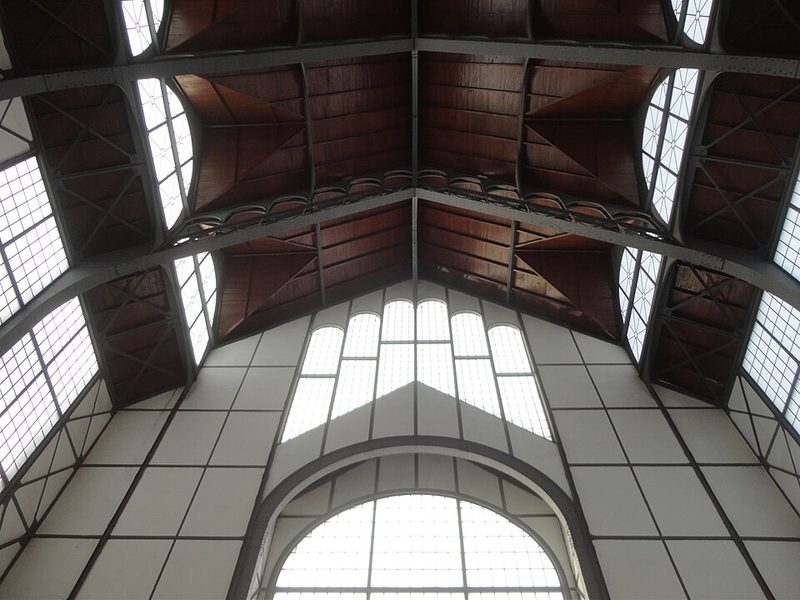
The building was designed and fabricated in Germany by the Dusseldorf-based firm of Bruno Mohring for the 1902 Dusseldorf International Art Exhibition. It was a temporary exhibition pavilion — an iron-and-glass structure in the Art Nouveau style, modular by design, meant to be assembled and disassembled. After the exhibition, the Mexican government purchased the building and had it shipped across the Atlantic in pieces.
It was reassembled in Mexico City in 1905 and initially served as the Museum of Natural History, housing geological, paleontological, and biological collections. The iron framework and glass panels gave the interior a light-filled, greenhouse-like quality that was perfect for displaying specimens. For most of the 20th century, this was where Mexico City schoolchildren came to see dinosaur bones and mineral samples.
The natural history collections eventually moved to Chapultepec, and the building sat empty for years before UNAM (the National Autonomous University of Mexico) took it over in 1975 and converted it into a contemporary art space. The Museo Universitario del Chopo opened in its current form and has operated as UNAM’s experimental arts venue ever since.
The building itself is worth seeing regardless of what’s exhibited inside. The iron structure is painted a dark gray-green, the glass panels flood the interior with natural light, and the proportions feel more like a Victorian greenhouse or a Parisian arcade than a Mexican museum. There’s nothing else like it in the city.
The Art Program
The Chopo’s exhibitions focus on contemporary art, with an emphasis on experimental, interdisciplinary, and politically engaged work. As a UNAM institution, it has the backing of one of Latin America’s most important universities, which gives it curatorial credibility and funding that most independent spaces can’t match.
Exhibitions change regularly and tend toward the challenging end of the spectrum. Expect video installations, performance art, sound art, political commentary, and work by emerging Mexican and international artists. The programming deliberately seeks out voices and perspectives that mainstream museums avoid. If the National Art Museum or the Palace of Fine Arts represent Mexico’s artistic establishment, the Chopo is the loyal opposition.
The museum also hosts film screenings, concerts, performance events, and lectures. The programming calendar is available on UNAM’s cultural websites and at the museum itself.
The Tianguis Cultural del Chopo
This is the reason many people know the Chopo’s name, even if they’ve never set foot inside the museum.
Every Saturday, the street next to the museum hosts the Tianguis Cultural del Chopo, one of the longest-running alternative/countercultural markets in Mexico. It started in 1980 when fans of rock, punk, and new wave music began gathering outside the museum to trade vinyl records, cassettes, and fanzines. The market has evolved over four decades but retains its identity as the epicenter of Mexico City’s alternative scene.
What you’ll find at the tianguis:
- Music: Vinyl records, CDs, and cassettes spanning punk, metal, goth, ska, industrial, hip-hop, and every subgenre imaginable. Both domestic Mexican acts and international imports. This is serious collector territory.
- Clothing: Band t-shirts, leather jackets, studded belts, patches, pins, Doc Martens (real and knockoff), and the full visual vocabulary of subcultural fashion.
- Fanzines and underground publications: Hand-printed zines, comics, stickers, and political literature.
- Piercings and tattoos: Several vendors offer on-the-spot piercings, and tattoo artists sometimes set up temporary stations.
- Food and drink: Street food vendors catering to the crowd.
The atmosphere on Saturdays is unlike anything else in Mexico City. Punks with mohawks, metalheads in battle vests, goths, skinheads (the non-racist variety — Mexico’s skinhead scene is largely apolitical or left-leaning), and curious tourists all mingle in a compact outdoor market that throbs with amplified music from competing vendors. It’s loud, it’s crowded, and it’s completely authentic.
The tianguis runs from roughly 10:00 AM to 4:00 PM on Saturdays. It’s free to walk through. The adjacent streets can feel a bit rough around the edges, but the market itself is generally safe — it’s been a well-established public event for over 40 years, and the vendors and regulars self-police effectively.
Practical Information
Location
The museum is at Dr. Enrique Gonzalez Martinez 10, Colonia Santa Maria la Ribera, near the intersection with Aldama. It’s about a 15-minute walk from the Monument to the Revolution or a 10-minute walk from the Moorish Kiosk in the Alameda de Santa Maria.
Getting There
- Metro: Buenavista station (Suburban Rail) or San Cosme station (Line 2) are both about a 10-minute walk.
- Metrobus: Line 1 stops at Buenavista, about 10 minutes on foot.
- Walking: From Roma Norte, it’s about 25-30 minutes on foot, or a quick Uber ride.
Hours and Admission
The museum is open Tuesday through Sunday, 11:30 AM to 7:00 PM. Closed Mondays. Admission is free or very low cost (UNAM subsidizes it). The Saturday tianguis operates independently of the museum’s schedule.
How Long to Spend
For the museum alone, 30-60 minutes depending on the exhibitions. For the Saturday tianguis, you could spend anywhere from 30 minutes (quick browse) to several hours (if you’re digging through vinyl crates). The ideal Saturday visit combines both: hit the tianguis in the morning, then step inside the museum when you need a break from the noise.
Neighborhood Context
Santa Maria la Ribera is one of CDMX’s oldest colonias, dating to the 1860s. It’s a working-class neighborhood with beautiful Porfirian architecture in varying states of preservation, anchored by the Alameda de Santa Maria and its famous Moorish Kiosk. The area has been gentrifying slowly, with cafes and galleries appearing alongside traditional businesses, but it retains a grittier, more local feel than Roma or Condesa.
The neighborhood is generally safe during the day, particularly around the museum and the Alameda. As with most areas of central CDMX, exercise standard awareness at night.
Who Should Visit
The Chopo is essential for anyone interested in contemporary art, subcultural history, or the side of Mexico City that doesn’t appear in most guidebooks. The museum’s exhibitions are genuinely challenging and often excellent. The Saturday tianguis is a portal into a counter-cultural tradition that’s been thriving since before many of its current participants were born.
It’s also just a great building. That iron-and-glass German structure, reassembled in a Mexican neighborhood, housing punk rock flea markets and UNAM art installations — it’s the kind of improbable combination that could only happen in this city.